
Decades ago, when I moved to Boston, the first job I had was at the Museum of Fine Arts (MFA). I had applied with the naive hope that my degrees from a Midwestern public college might enable me to find work in one of the many offices there. I soon learned that the best jobs at the MFA went to those who didn’t need them, people with pedigrees, trust funds, and Ivy League diplomas. I was hired as a minimum wage security guard.
I spent many hours there, initially fascinated by the sarcophagi, sculptures, temples, tombs, and other treasures, often ransacked from developing countries. But eventually boredom set in.
Officially, it was forbidden to read while on duty, and I was expected to give my full attention to safeguarding the museum’s stolen property. Nonetheless, I availed myself of the city’s then abundant used bookstores, now all but extinct, where I purchased paperbacks that I tore into pocket-sized leaves. Surreptitiously, I read the disassembled 4,000-plus pages of Marcel Proust’s masterpiece “In Search of Lost Time.”
While Proust always remained one of my favorite authors, over the years I thought less frequently about his serpentine sentences, byzantine genius, and the proverbial “cork-lined room” where the reclusive author spent his last days – until Covid.
Almost overnight, I found myself locked down alone in a midrise, one-bedroom apartment in Quincy, Massachusetts. Within close earshot of the rumbling Red Line, the place is fairly unremarkable except for its windswept balcony and astonishing sunsets.
With the outbreak, ominous signs soon appeared in the hallways about masks, disinfection procedures, and instructions to take the elevator one at a time. All surfaces, packages, and people were regarded as potential sources of contamination. The masked residents barricaded themselves, and avoided each other like the plague.
The suddenly shrunken world reminded me of the young Marcel’s Aunt Léonie in Swann’s Way, who “after the death of her husband, my Uncle Octave, no longer wished to leave, first Combray, then within Combray her house, then her bedroom, then her bed . . .”
Although Proust, who died in 1922, does not reference the Spanish flu, which killed 50 million people, he lived through it. In the book’s last volumes, he wrote about the concurrent cataclysm of his time, the Great War. The creative splendor of “La Belle Époque,” or “The Beautiful Age,” with Paris at its center, came to a brutal end in the mustard gas and mud of Verdun.
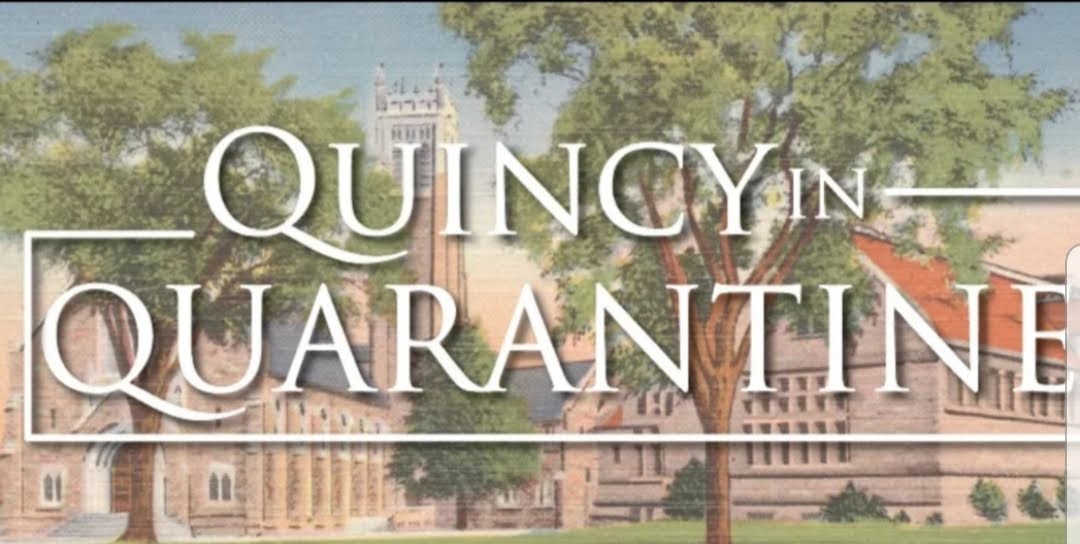
A new historical line of demarcation has now been drawn: Before Covid (B.C.) and after. The Quincy Chronicles, a collection of photographs and digital collages, are about vanished universes and the ashes of memory.

 The Quincy Chronicles