

It’s nearly three years since the indelible March, 2020.
At the start of the pandemic, I used to receive text alerts when Governor Baker was expected to address the crisis, and watched his appearances faithfully. In one instance, unless it was my imagination, he meant to say “surge,” referring to the cresting tsunami to slam these shores, and instead said, “scourge.”
As we all awaited the exponential rise in cases, I could not have been by myself in coming down with what I self-diagnosed as “Pre-Traumatic Stress.”
At the height of lock-down, I sometimes used to wander shell-shocked through the neighborhood. With businesses shuttered and people sheltering in place, pedestrians were rare on the dead streets. In the absence of humans, wildlife reclaimed the land.
Nor was there any traffic. It was possible to walk smack in the middle of Hancock Street, one of Quincy’s always clogged arteries, without barely encountering a vehicle. Except for an odd delivery or trash truck, a bus devoid of passengers, or panicked ambulance, it was as if a crippling, snowless blizzard had struck.
Only skeleton crews of essential workers were to be seen – electricians, plumbers, and others in fluorescent vests, who kept the lights on and the water running. In the ashes of what seemed a former life, I was astonished to see them at construction sites building an uncertain future.
Before at-home tests, I once fell ill. The only option at that time was to visit an emergency testing facility. Long queues of the sick, with scared eyes above the homemade masks they wore, tried in vain to keep their distance from each other. (As it turned out, I had an infected tooth and the realization in a dentist’s chair that I hadn’t been touched in over a year.)
Another time during quarantine, the fire alarm in my apartment, where I had long been hostage, beeped madly due to a depleted battery. To avoid contact with others, I walked to a 24-hour drugstore in the middle of the night, but they were sold out.
And then there was the elation I felt when my lucky number finally came up, and I was eligible to receive the vaccine. Under the watchful eye of the National Guard, heroic healthcare workers at a high school injected the orderly herds on a basketball court. All of us no doubt hoped the scourge was coming to an end.
The dead are no longer stored in makeshift morgues, or socially distanced funerals held in parking lots. Nor is the city, as if a neutron bomb had fallen, a necropolis.

It is our third Covid Winter. As regular as snow in February, most of the state was again bright red on the color-coded maps that indicate its alert status. This year the portmanteau “tripledemic” was coined to tally the maladies.
It is a difference by degree like 0 and -1F.
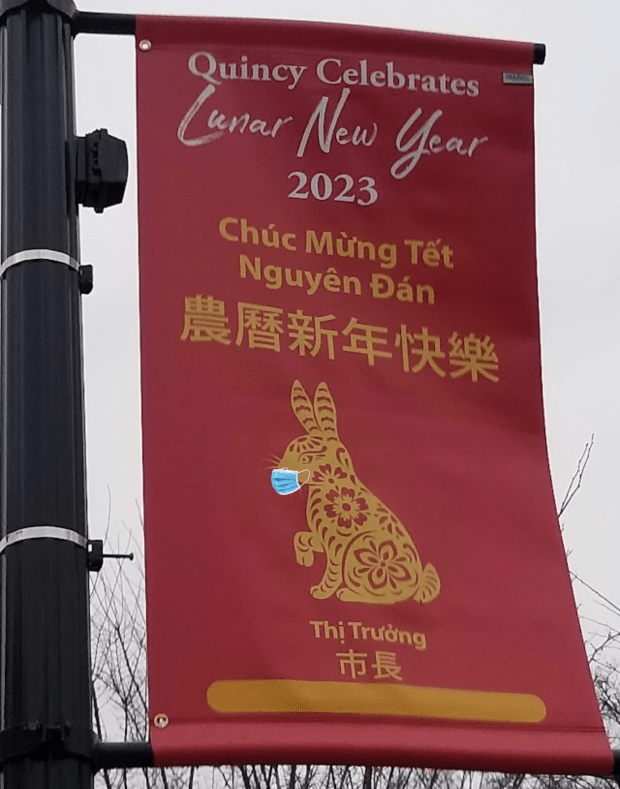
In a sequence of Greek letters or titles of Borges’ short stories, a more contagious and vaccine evasive variant has emerged. Less virulent than its predecessors, the Year of the Rabbit may yet to prove to be lucky.
The tried-and-true techniques to weather a New England winter are essentially two: hunkering down and bundling up.
The first strategy resembles home remedies for seasonal affective disorder, “SAD.” Fires, toast, tea, cocoa, blankets, and spirits and have long warded off arctic spells, and kept the chill at bay. Three years later, they can be cold comforts. Confinement is more a bunker than a cozy cabin in the woods.
Besides parkas, hats, boots, gloves, and other paraphernalia, this season the cautious add an extra layer of protection. Masks are the most visible reminder that the virus lingers.
“Demographics is destiny,” wrote the philosopher Auguste Comte. (Early on, the maxim was used to explain the sky-high deaths in crowded NYC.)
Though no one would mistake Quincy for Manhattan, the saying hits home. In my building, for one, people literally live on top of each another. Plus, with over a third of its residents Asian, mainly Chinese, masks were not uncommon pre-pandemic.
At the start, handkerchiefs, bandanas, and cut-up t-shirts were used for homespun designs. They were later replaced by surgical styles. (Fashionistas sport high-end models by Balenciaga and Burberry. ) But the KN95, and its imitators, are practically de rigueur.
In my case, common sense prevails. I follow guidance to mask up, especially in crowds and at times of high transmission, best measured these days by wastewater samples. All the same, the sight of others driving or walking alone strikes me as overkill.
Looking like beaked doctors of pestilences past, the city still seems a masquerade askew.
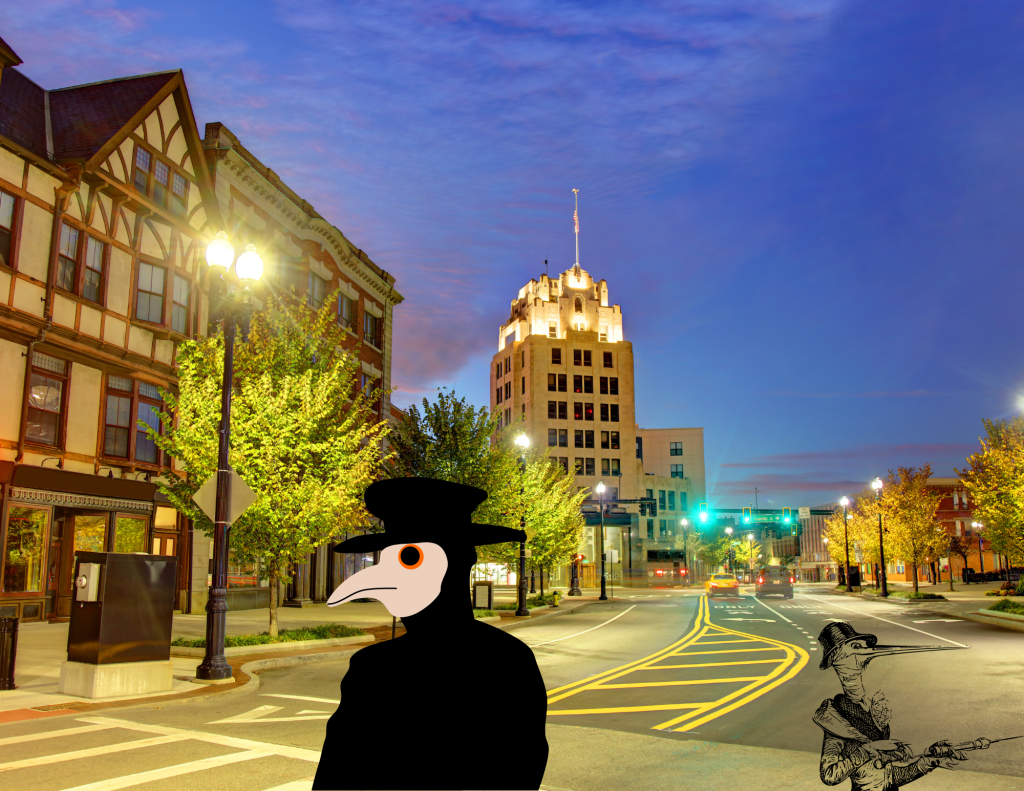
The vigilant continue prophylaxis. Social circles have tightened. Acquaintances have vanished. Many have gone remote. Gatherings are few and far between.
The risk of surface infection has proven less grave than first thought when mail and packages went unopened for days. (At the time rubber gloves and bleach were limited, there was a viral video of a besplotched healthcare worker who used purple dayglo paint to demonstrate the principles of cross-contamination. The microbe, everlasting as glitter, confetti, or radioactivity, swiftly swept her residence in a violet wave.)
The best available medical advice then was to wash one’s hands repeatedly in warm water to the tune of “Happy Birthday” sung twice. Though the days of scrubbing until raw are over, the melody remains fixed, a permanent party of one. “And many more.”
New dexterities have developed. Regarded as risky, handshakes are replaced by more distant cousins – fists. Public items like elevator buttons, doorknobs, and crossing signals, are avoided. Tissues, pens, umbrellas, or keys are used ad hoc for protection. In lieu of fingers, backhands, wrists, elbows, and shoulders are employed to minimize exposure. (An immunocompromised friend speculates future generations may subtract or add digits.)

With Covid less lethal these days, the decision to isolate or not is informed by fresh paralysis. Plagued by staff and service cuts, safety concerns, shutdowns, and “slow zones,” transit is at a crawl. (With long delays, passengers are packed.) Rideshares with inflated prices are difficult to obtain. And with the meltdown of air travel, like Icarus our wings are clipped.
. . .
At the onset, medical gear was unavailable. Desperate nurses wore garbage bags. Canned, frozen, and paper products, flour, appliances, spare parts, and other goods were scarce.
Shortages come and go: cough, cold and flu medicines, pet foods, gas, cars and bikes, wood, wheat, eggs, semiconductors, acetaminophen, adderall, sriracha and blood, have all been insufficient. (A while ago, cartels were blamed for a dearth of avocados.)
The supply chain is backlogged and disrupted. One day, lettuce, spices, or sponges are abundant, the next nonexistent. Prices have increased greatly.
Home is safe asylum. With few visitors, it seemed wise to convert a coat closet in the hallway to a pantry. The sense of siege is enhanced.
. . .
I can’t precisely recall how many vaccines or boosters I’ve had. But I won’t forget my last shot.
There were two mobbed service points at the pharmacy – prescriptions and injections. A woman wearing a hijab, white jacket, and name tag, rushed from one window to the next. At a register, she searched piles of drugs. I heard her complain that she had no change, and that receipts wouldn’t print. The phone rang off the hook. Her efforts were hindered by a crashing network.
Despite delays, the vaccine line was convivial. An elderly lady, long waiting, remarked that she felt grateful. A mother shared details of an earlier visit to the store when she had confronted a shopper hoarding formula. Another told us about a family visit she made to Alaska and was stranded four days in Seattle.
Over the course of hours, the pharmacist administered to each patient. When the time came to roll up my sleeve, I thanked her. Leila told me she appreciated my patience, and confessed that she was no stranger to abuse. (I wondered if her call to duty had silenced even a single xenophobe’s voice.)
Like a revived Theater of the Absurd, scenes of bedlam are widely staged.
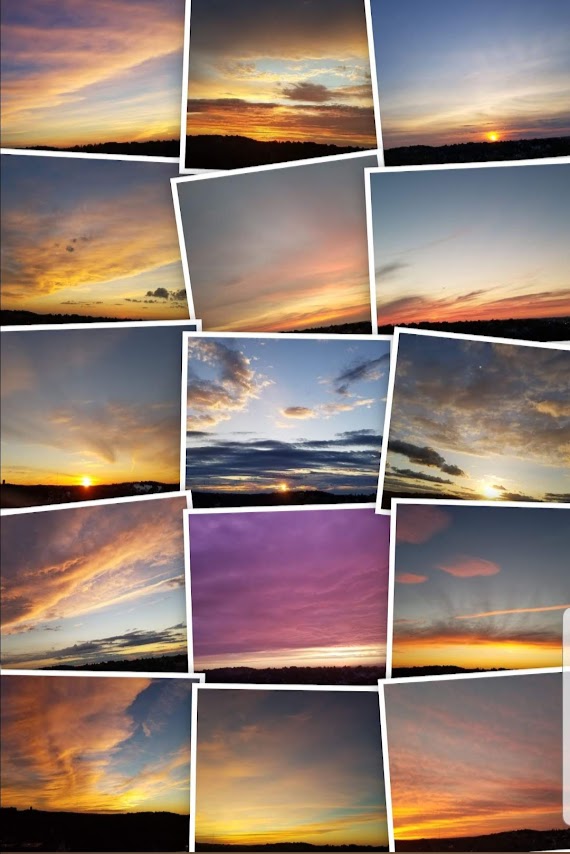
The ordeal is a Dark Age that exists apart from time when Tuesday was Thursday, January confused with June, 2021 for 22, and dusk for dawn.
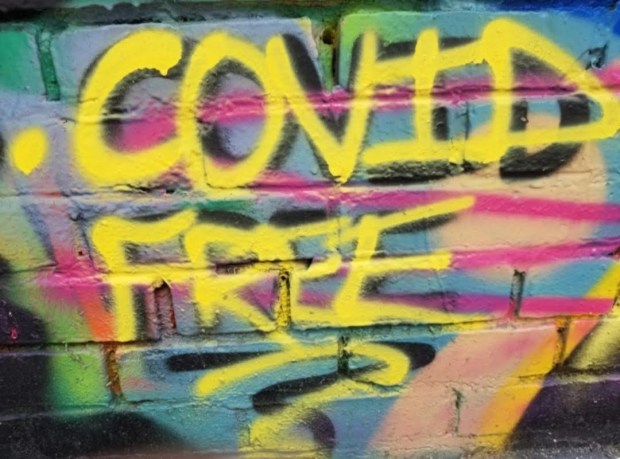
Pre-Covid, my favorite haunts were Central Square and Downtown Crossing, once easy, straight shoots on the Red Line. They are ghosts of themselves.
Central Square has grown seedier. There are many casualties. Its packed cafes and restaurants are depopulated. Patrons who competed for seats, lingering over laptops and lattes, shun close spaces. Diners, mostly take-out, calculate risk reward ratios. Is the prized vindaloo worth losing one’s sense of taste, or really to die for?
Downtown’s shoppers and commuters have fled to virtual realities. Office towers stand empty. Customers, formerly restricted, are now unrestrained but crowds have thinned. On life support before Covid, retail has suffered and perished with one exception. Dwindling tourists score Sour Diesel and Bostoner t-shirts as keepsakes of Freedom Trail walks. There’s an outbreak of disturbing incidents.
Always sketchy, downtown’s dispossessed have multiplied. The place appears a pilgrimage for the afflicted like Fatima or Lourdes.
. . .
 The Quincy Chronicles